The pipeline is the root configuration object in an Atkins file.
Properties
| Field | Type | Default | Description |
|---|---|---|---|
name |
string | - | Pipeline name for display |
help |
string | - | Purpose, shown by atkins --help |
dir |
string | . |
Working directory for all jobs |
vars |
map | {} |
Pipeline-level variables |
env |
object | {} |
Environment variables |
jobs |
map | - | Job definitions |
tasks |
map | - | Alias for jobs |
include |
string/list | - | External file inclusion |
when |
object | - | Skill activation conditions |
when
Object
| Field | Type | Description |
|---|---|---|
files |
list | Files that must exist for pipeline to be enabled |
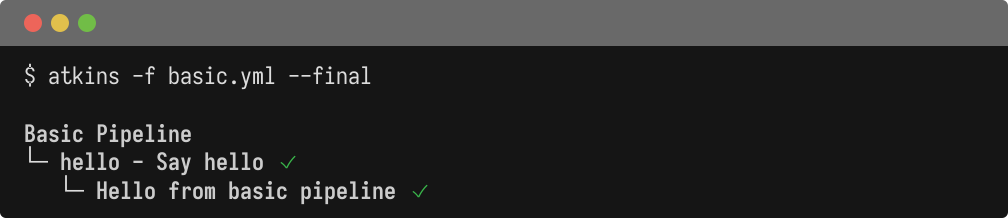
Basic Pipeline
  name: Basic Pipeline

jobs:
  hello:
    aliases: [default]
    desc: Say hello
    steps:
      - run: echo "Hello from basic pipeline"
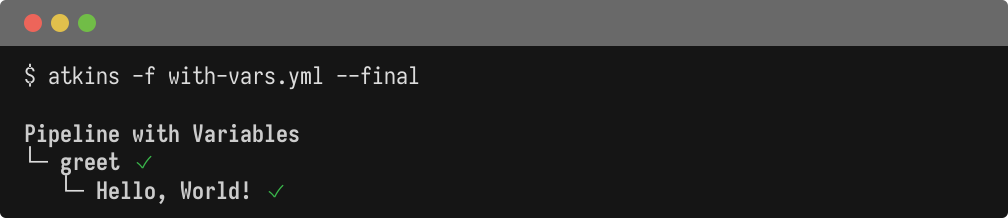
With Variables
  name: Pipeline with Variables

vars:
  greeting: Hello
  target: World
  items:
    - alpha
    - beta
    - gamma

jobs:
  greet:
    aliases: [default]
    steps:
      - run: echo "${{ greeting }}, ${{ target }}!"
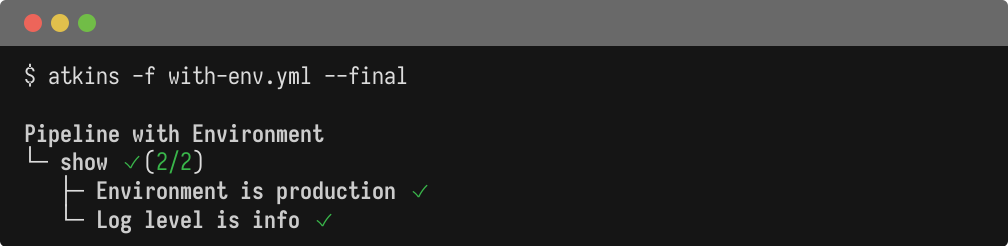
With Environment
  name: Pipeline with Environment

env:
  vars:
    APP_ENV: production
    LOG_LEVEL: info

jobs:
  show:
    aliases: [default]
    steps:
      - run: echo "Environment is $APP_ENV"
      - run: echo "Log level is $LOG_LEVEL"
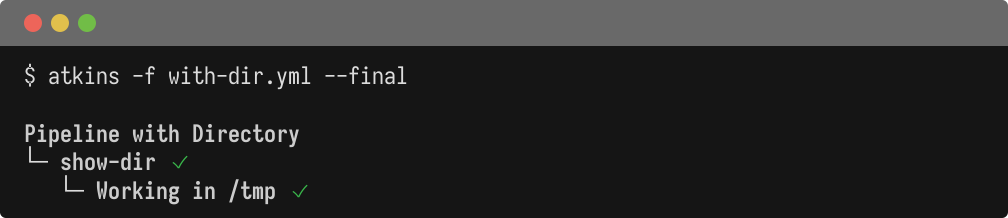
With Working Directory
  name: Pipeline with Directory

dir: /tmp

jobs:
  show-dir:
    aliases: [default]
    steps:
      - run: echo "Working in $(pwd)"
Environment Inheritance
Atkins passes the full shell environment to all commands. You don't need to explicitly declare which variables to inherit.
  jobs:
  show-env:
    steps:
      # $HOME, $PATH, $USER etc. are all available
      - run: echo "Home is $HOME"