Atkins supports a Taskfile-compatible structure. The main differences are in interpolation syntax and shell substitution. Simple Taskfiles without interpolation often work without any changes.
Full Example
Here's a complete side-by-side comparison showing variable interpolation, shell substitution, and task dependencies:
  # Atkins syntax - runnable with: atkins -f atkins-after.yml
vars:
  project_name: my-app
  commit: dev
  timestamp: latest

tasks:
  default:
    desc: Run all build tasks
    cmds:
      - task: clean
      - task: build
      - task: package

  clean:
    desc: Clean build artifacts
    cmds:
      - echo "Cleaning ${{ project_name }} build files..."
      - echo "rm -rf dist/"

  build:
    desc: Build the project
    vars:
      build_flags: -ldflags '-X main.Version=${{ commit }}'
    cmds:
      - echo "Building ${{ project_name }} at commit ${{ commit }}"
      - echo "go build ${{ build_flags }} ./..."

  package:
    desc: Package for distribution
    deps: [build]
    cmds:
      - echo "Packaging ${{ project_name }}-${{ timestamp }}.tar.gz"
  # Taskfile syntax (reference only - not runnable with Atkins)
version: '3'

vars:
  project_name: my-app
  commit:
    sh: git rev-parse --short HEAD
  timestamp:
    sh: date +%Y%m%d

tasks:
  default:
    desc: Run all build tasks
    cmds:
      - task: clean
      - task: build
      - task: package

  clean:
    desc: Clean build artifacts
    cmds:
      - echo "Cleaning {{.project_name}} build files..."
      - rm -rf dist/

  build:
    desc: Build the project
    vars:
      build_flags: "-ldflags '-X main.Version={{.commit}}'"
    cmds:
      - echo "Building {{.project_name}} at commit {{.commit}}"
      - echo "go build {{.build_flags}} ./..."

  package:
    desc: Package for distribution
    deps: [build]
    cmds:
      - echo "Packaging {{.project_name}}-{{.timestamp}}.tar.gz"
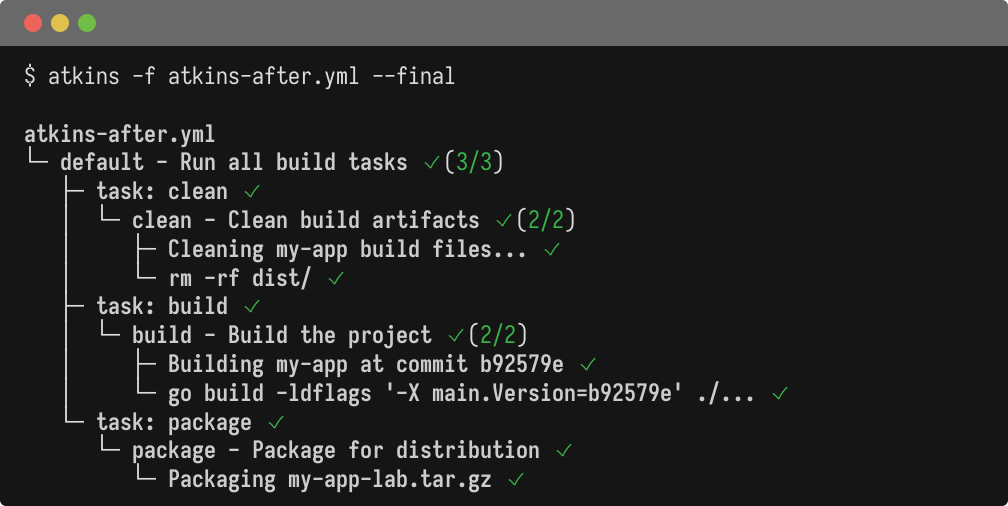
Structure Comparison
The overall structure is nearly identical. Atkins doesn't require a version
field.
Taskfile:
  version: '3'

vars:
  key: val

tasks:
  default:
    cmds:
      - cmd: echo hello
      - task: other
Atkins:
  vars:
  key: val

tasks:
  default:
    cmds:
      - cmd: echo hello
      - task: other
The task: <name>
syntax for invoking other tasks works identically in both tools.
Shell Substitution
Taskfile uses the sh:
field for dynamic values. Atkins uses bash-style $(...)
which can also be used inline within commands.
Taskfile:
  vars:
  uname:
    sh: uname -n
Atkins:
  vars:
  uname: $(uname -n)
Variable Interpolation
Taskfile uses Go templates which require quoting in YAML. Atkins uses ${{ }}
syntax which is YAML-safe.
Taskfile:
  vars:
  foo: bar
  bar: "{{.foo}}"  # Must be quoted

tasks:
  default:
    cmds:
      - echo "{{.foo}}"
Atkins:
  vars:
  foo: bar
  bar: ${{ foo }}  # No quotes needed

tasks:
  default:
    cmds:
      - echo "${{ foo }}"
Benefits of the Atkins syntax:
- No quoting required in YAML
- No
.prefix for variable names - Doesn't conflict with bash
${var}syntax
Environment Variables
Taskfile requires explicit environment declarations and doesn't inherit from the shell by default. Atkins inherits the full environment automatically.
You can still declare environment variables at any level:
  env:
  vars:
    MY_VAR: value

tasks:
  build:
    env:
      vars:
        GOOS: linux
    steps:
      - run: go build
Simple Tasks
Both support shorthand syntax for single-command tasks:
  tasks:
  up: docker compose up -d
  down: docker compose down
Listing Tasks
Taskfile:
task --list-all # -l requires descriptions
Atkins:
atkins -l # Shows all tasks; uses command as description if none provided
Atkins always shows tasks, displaying the command when no description is set.
What Works Directly
Simple Taskfiles without interpolation work identically:
  tasks:
  up: docker compose up -d --remove-orphans
  down: docker compose down --remove-orphans
Summary
| Feature | Taskfile | Atkins |
|---|---|---|
| Version field | version: '3'
(required) |
Not required |
| Variable interpolation | {{.var}} |
${{ var }} |
| Shell substitution | sh: command |
$(command) |
| Task invocation | task: name |
task: name |
| Dependencies | deps: |
depends_on: |
| Conditionals | preconditions:
, status: |
if:
(expr-lang) |
| Deferred commands | defer: |
deferred: true
or defer: |
| Loops | for: |
for: |
| Includes | includes: |
include: |
| Environment loading | dotenv: |
env: include:
or vars: include: |
| Hidden tasks | internal: true |
show: false |
| File caching | sources:
, generates: |
Not supported |
| Watch mode | --watch |
Not supported |
| Binary size | ~15MB | ~10MB |