Atkins supports a GitHub Actions-inspired syntax with jobs:
and steps:
, familiar for teams that use GHA workflows. Atkins runs similar job definitions locally and in any CI environment, and can distribute them across your own agents via the CI/CD server
. It does not replace what GitHub hosts for you: triggers, runners, the marketplace and secrets stay where they are.
Full Example
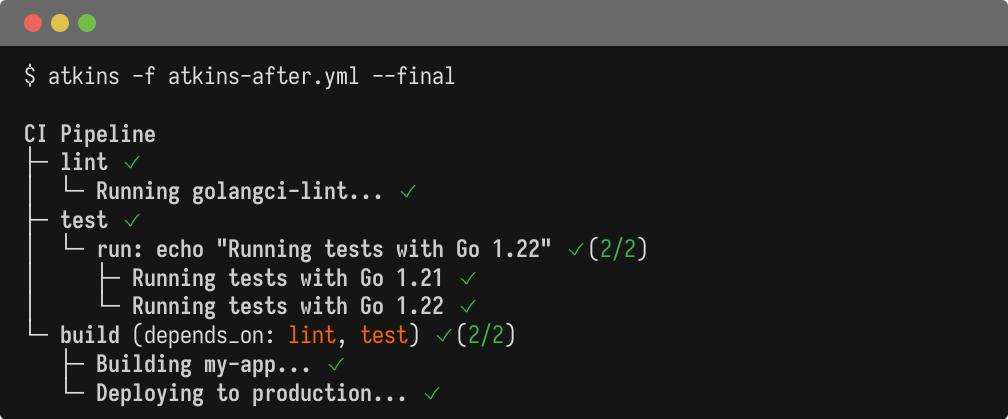
Here's a complete CI pipeline comparison showing jobs, dependencies, matrix builds, and conditional execution:
  # Atkins syntax - runnable with: atkins -f atkins-after.yml
name: CI Pipeline

vars:
  app_name: my-app
  branch: main
  go_versions:
    - '1.21'
    - '1.22'

jobs:
  lint:
    detach: true
    steps:
      - name: Run linter
        run: echo "Running golangci-lint..."

  test:
    detach: true
    steps:
      - name: Run tests for each Go version
        for: version in go_versions
        run: echo "Running tests with Go ${{ version }}"

  build:
    aliases: [default]
    depends_on: [lint, test]
    steps:
      - name: Build
        run: echo "Building ${{ app_name }}..."
      - name: Deploy
        if: branch == "main"
        run: echo "Deploying to production..."
  # GitHub Actions workflow syntax (reference only - not runnable with Atkins)
name: CI Pipeline

on:
  push:
    branches: [main]
  pull_request:
    branches: [main]

env:
  APP_NAME: my-app

jobs:
  lint:
    runs-on: ubuntu-latest
    steps:
      - uses: actions/checkout@v4
      - name: Run linter
        run: echo "Running golangci-lint..."

  test:
    runs-on: ubuntu-latest
    strategy:
      matrix:
        go-version: ['1.21', '1.22']
    steps:
      - uses: actions/checkout@v4
      - uses: actions/setup-go@v5
        with:
          go-version: ${{ matrix.go-version }}
      - name: Run tests
        run: echo "Running tests with Go ${{ matrix.go-version }}"

  build:
    runs-on: ubuntu-latest
    needs: [lint, test]
    steps:
      - uses: actions/checkout@v4
      - name: Build
        run: echo "Building ${{ env.APP_NAME }}..."
      - name: Deploy
        if: github.ref == 'refs/heads/main'
        run: echo "Deploying to production..."
Syntax Comparison
GitHub Actions:
  name: Build

on: [push]

jobs:
  build:
    runs-on: ubuntu-latest
    steps:
      - uses: actions/checkout@v4
      - name: Build
        run: go build ./...
Atkins:
  name: Build

jobs:
  build:
    steps:
      - name: Build
        run: go build ./...
Key Differences
No Triggers, and Runners Are Labels
Atkins has no equivalent to on:
. Nothing watches your repository for pushes, tags or pull requests; a run starts when something invokes atkins
. Use your existing CI, a cron job, or a webhook receiver to do the invoking.
runs-on:
has a partial equivalent. With the CI/CD server
, an agent advertises what it can run, and a dispatched job only lands on an agent advertising every label it asks for:
  # The agent declares what it can run
atkins worker --labels linux,arm64,docker

# The dispatching machine asks for those labels
ATKINS_LABELS=linux,arm64,docker atkins --dispatch build
ATKINS_LABELS
only matters together with --login
and --dispatch
; a plain atkins build
runs on the machine you typed it on regardless of the variable. Unlike GitHub's hosted runners, you provide the machines.
No uses:
Actions
Atkins has no equivalent to GitHub's action marketplace. Actions like actions/checkout
or actions/setup-go
must be replaced with shell commands or handled by your CI environment:
  # GHA actions have no Atkins equivalent
# Checkout: handled by CI before invoking Atkins
# Setup: use your environment's package manager or pre-installed tools
Inline Job Invocation
Atkins supports task:
to invoke another job inline within a step. GitHub Actions has no equivalent; GHA jobs form a DAG via needs:
and cannot call each other mid-execution.
Atkins:
  jobs:
  build:
    steps:
      - task: lint      # invoke lint job here
      - task: test      # then test job
      - run: go build ./...

  lint:
    steps:
      - run: golangci-lint run

  test:
    steps:
      - run: go test ./...
In GHA, this requires expressing the full dependency graph upfront with needs:
.
Field Name Differences
| GitHub Actions | Atkins |
|---|---|
runs-on |
ATKINS_LABELS
(agent labels) |
needs |
depends_on: |
Jobs and Dependencies
GitHub Actions:
  jobs:
  test:
    runs-on: ubuntu-latest
    steps:
      - run: go test ./...

  build:
    needs: test
    runs-on: ubuntu-latest
    steps:
      - run: go build ./...
Atkins:
  jobs:
  test:
    steps:
      - run: go test ./...

  build:
    depends_on: test
    steps:
      - run: go build ./...
Variables
GitHub Actions:
  env:
  MY_VAR: value

jobs:
  build:
    env:
      BUILD_VAR: ${{ env.MY_VAR }}
    steps:
      - run: echo $BUILD_VAR
Atkins:
  vars:
  my_var: value

jobs:
  build:
    env:
      vars:
        BUILD_VAR: ${{ my_var }}
    steps:
      - run: echo "$BUILD_VAR"
Secrets
GitHub Actions provides encrypted secrets via the secrets
context. Atkins has no built-in secrets management.
GitHub Actions:
  jobs:
  deploy:
    steps:
      - run: ./deploy.sh
        env:
          API_KEY: ${{ secrets.API_KEY }}
          DB_PASSWORD: ${{ secrets.DB_PASSWORD }}
Atkins:
  jobs:
  deploy:
    steps:
      # Secrets must come from the environment
      - run: ./deploy.sh
Pass secrets via environment variables when invoking Atkins:
API_KEY=xxx DB_PASSWORD=yyy atkins deploy
Or use a secrets manager that populates the environment (Vault, AWS Secrets Manager, direnv
, etc.).
Matrix Builds
GHA's matrix strategy maps to Atkins' for:
loops. Atkins supports multi-iterator syntax for cartesian products (all combinations), which is a direct equivalent to GHA's multi-dimensional matrix:
GitHub Actions:
  jobs:
  build:
    strategy:
      matrix:
        os: [linux, darwin]
        arch: [amd64, arm64]
    runs-on: ubuntu-latest
    steps:
      - run: echo "Building for ${{ matrix.os }}-${{ matrix.arch }}"
Atkins (multi-iterator):
  vars:
  os: [linux, darwin]
  arch: [amd64, arm64]

jobs:
  build:
    steps:
      - for:
          - os in os
          - arch in arch
        run: echo "Building for ${{ os }}-${{ arch }}"
Both produce 4 iterations: linux-amd64
, linux-arm64
, darwin-amd64
, darwin-arm64
.
Key advantages of Atkins' approach:
- No separate
strategyblock - iterators are defined inline - Variables can come from
vars:, inline arrays, or shell commands - Works with any step type (
run:,task:,cmd:) - Nested tasks can add additional iteration dimensions
For single-dimension iteration:
  vars:
  go_versions: ['1.21', '1.22']

jobs:
  test:
    steps:
      - for: version in go_versions
        run: echo "Testing with Go ${{ version }}"
Conditional Execution
GitHub Actions:
  - name: Deploy
  if: github.ref == 'refs/heads/main'
  run: echo "Deploying..."
Atkins:
  vars:
  branch: $(git rev-parse --abbrev-ref HEAD)

jobs:
  deploy:
    steps:
      - name: Deploy
        if: branch == "main"
        run: echo "Deploying to production..."
Atkins uses expr-lang
for condition evaluation. The branch
variable is not built-in; define it explicitly in vars:
(here using a dynamic shell command).
Parallel Execution
GitHub Actions runs jobs in parallel by default. Atkins runs jobs sequentially unless you use detach: true
:
  jobs:
  lint:
    detach: true  # Run in background
    steps:
      - run: golangci-lint run

  test:
    detach: true  # Run in parallel with lint
    steps:
      - run: go test ./...

  build:
    depends_on: [lint, test]  # Wait for both
    steps:
      - run: go build ./...
Summary
| Concept | GitHub Actions | Atkins |
|---|---|---|
| Triggers | on: [push] |
Not supported (use CI or cron) |
| Runner selection | runs-on: |
ATKINS_LABELS
on self-hosted agents |
| Hosted runners | GitHub-hosted | Machines you provide |
| Marketplace actions | uses: actions/checkout@v4 |
No equivalent |
| Job dependencies | needs: |
depends_on: |
| Inline job calls | Not supported | task:
in steps |
| Secrets | ${{ secrets.X }} |
Environment variables |
| Matrix | strategy.matrix |
for:
with multi-iterator |
| Parallel | Default | detach: true |
| Run history | Workflow runs | Jobs recorded via /api/dispatch |
Best Practices
- Atkins runs commands; use your CI platform for triggers and secrets
- Run the same tasks locally that CI runs
- Call
atkinsfrom your GHA workflow for consistency - To keep the work on your own machines, attach them with
atkins --loginand let agents claim the jobs instead